

The Future of Health in Mozambique: Innovations and Opportunities in 2026
In 2026, Mozambique finds itself at a transformative crossroads in the health sector. The convergence of persistent challenges, such as limited access to basic healthcare for about 50% of the population, and the unstoppable advancement of technology, creates a unique scenario. The country's vast geographical expanse, developing infrastructure, and the need for specialization in remote areas are known obstacles. However, it is precisely in this context that digital transformation reveals itself not only as a solution but as the main driver for a revolution in healthcare delivery. Inademy is committed to being your strategic partner, empowering you to navigate and thrive in this new Mozambican health ecosystem.
The challenges are clear: the concentration of medical resources in large cities like Maputo and Matola leaves vast rural regions with precarious access to essential services. The lack of modern equipment, the scarcity of medicines, and the need for continuous professional development are significant barriers. However, each of these challenges is an open door to technological innovation. The need to reach isolated populations drives telemedicine; the shortage of specialists stimulates the use of artificial intelligence for diagnostic support; and inefficiency in information management fosters the adoption of electronic health records. Technology, therefore, transcends mere modernization; it is a vital vehicle for democratizing access to health throughout Mozambique. Inademy offers a range of training programs and resources specifically designed to prepare you for these emerging opportunities, ensuring you are at the forefront of innovation.
Current Challenges and the Digital Opportunity
The Mozambican health landscape in 2026 is marked by significant disparities in access and quality of services. The concentration of health units and specialists in urban areas, such as Maputo and Matola, contrasts with the scarcity of resources in rural areas, where the majority of the population resides. This geographical inequality is compounded by the lack of updated medical equipment, the intermittent availability of essential medicines, and the constant need for training and updating for health professionals. However, each of these obstacles represents fertile ground for the application of innovative technological solutions. Telemedicine emerges as a direct response to the need to deliver care to remote locations, overcoming physical barriers. Artificial intelligence offers diagnostic support in areas with few specialists, while the digitalization of health records promises to optimize information management and reduce errors. Technology, in this context, is not just a means of modernization but an essential tool for equity in healthcare access. Inademy is prepared to equip you with the necessary skills to capitalize on these opportunities through courses and resources that directly address the needs of the Mozambican market.
The Indispensable Role of Digital Transformation
Digital transformation in Mozambican healthcare in 2026 is not an option but an imperative for the sustainability and improvement of the system. It implies a complete redefinition of how health services are delivered, managed, and accessed by citizens. The goal is the integration of digital technologies into all facets of the system – from the administration and management of health units to the direct provision of clinical care. The objective is to build a more efficient, accessible, equitable, and, above all, patient-centered health ecosystem. Digitalization promises to optimize operational processes, reduce costs, increase diagnostic accuracy, and enable more continuous and personalized patient monitoring. For health professionals, this transition means acquiring new digital skills and adapting to new work methodologies, opening up a range of previously unimaginable career opportunities. The future of health in Mozambique will be intrinsically digital, and Inademy is your fundamental partner on this journey of empowerment and professional growth.
"Technology in healthcare is not a luxury; it is a bridge to equity and a healthier future in Mozambique."
Technological Innovations Shaping Healthcare in Mozambique
The healthcare landscape in Mozambique is rapidly being redefined by a set of disruptive technological innovations. These technologies, ranging from telemedicine to artificial intelligence and electronic health records, are not just futuristic concepts; many are already being implemented and demonstrating a tangible impact on improving access to and quality of care. The adoption of these digital tools is crucial for overcoming the geographical and knowledge barriers that have historically limited the sector's development, while simultaneously creating new and exciting career opportunities for Mozambican professionals. Inademy is at the forefront of this revolution, offering training and resources to help you master these new technologies and thrive in the job market.
Telemedicine: Connecting Patients and Professionals Remotely
Telemedicine is emerging as one of the most impactful innovations for a country with Mozambique's geographical diversity. This technology allows patients in remote areas, where access to doctors and specialists is scarce or non-existent, to receive medical advice, preliminary diagnoses, and continuous follow-up without the need for long and costly travel. It is estimated that telemedicine can effectively manage up to 80% of routine and follow-up consultations, relieving pressure on physical health units and optimizing resource utilization. For healthcare professionals, telemedicine expands their reach, enabling them to provide care to a significantly larger number of people and in locations where it was previously impossible. The successful implementation of this modality requires reliable communication infrastructure, secure digital platforms, and properly trained professionals to interact effectively with patients through virtual means. This area is generating a growing demand for specialists capable of managing, operating, and innovating in these remote healthcare systems, a field where Inademy offers specialized training.
Artificial Intelligence: Empowering Diagnosis and Clinical Management
Artificial Intelligence (AI) is revolutionizing how diagnoses are made and how medical data is analyzed. In Mozambique, innovative startups and healthcare institutions are exploring AI's potential to optimize patient flow, prioritize cases, and assist professionals in clinical decision-making. AI's ability to analyze medical images, such as X-rays and CT scans, with remarkable speed and accuracy is particularly valuable in contexts where access to specialists like radiologists is limited. By identifying subtle patterns that may escape the human eye, AI accelerates the diagnostic process, allowing treatments to begin earlier and significantly improving patient outcomes. Furthermore, AI can be used to analyze large volumes of health data, identifying epidemiological trends and predicting disease outbreaks. The integration of AI into the clinical workflow is creating a new generation of career opportunities for professionals with expertise in data science, machine learning, and medicine, areas that Inademy is beginning to explore in its programs.
Electronic Health Records (EHR): The Foundation of an Efficient System
The transition from traditional paper-based health records to electronic systems is a fundamental step towards modernizing healthcare in Mozambique. Electronic Health Records (EHR) centralize patients' clinical and administrative information in a secure and accessible digital format. This digitalization not only minimizes common errors associated with illegible handwriting or lost documents but also ensures that any authorized healthcare professional can quickly access a patient's complete medical history. Studies indicate that the effective implementation of EHR can reduce medical errors by up to 30%, improving patient safety. Additionally, EHRs are essential for collecting and analyzing health data on a large scale, providing crucial information for public health management, identifying epidemiological patterns, and evaluating the effectiveness of health policies. It is predicted that an increasing percentage of health units in Mozambique will adopt EHR systems in the coming years, driving demand for qualified professionals to manage and maintain these digital platforms. Explore our career resources to find opportunities in this growing field.
Technology | Main Impact in Mozambique | Application Examples |
|---|---|---|
Telemedicine | Expanding access to care in remote areas | Virtual consultations, remote monitoring |
Artificial Intelligence | Diagnostic support and data management | Medical image analysis, patient triage |
Electronic Health Records | Improving information efficiency and security | Patient history centralization, error reduction |
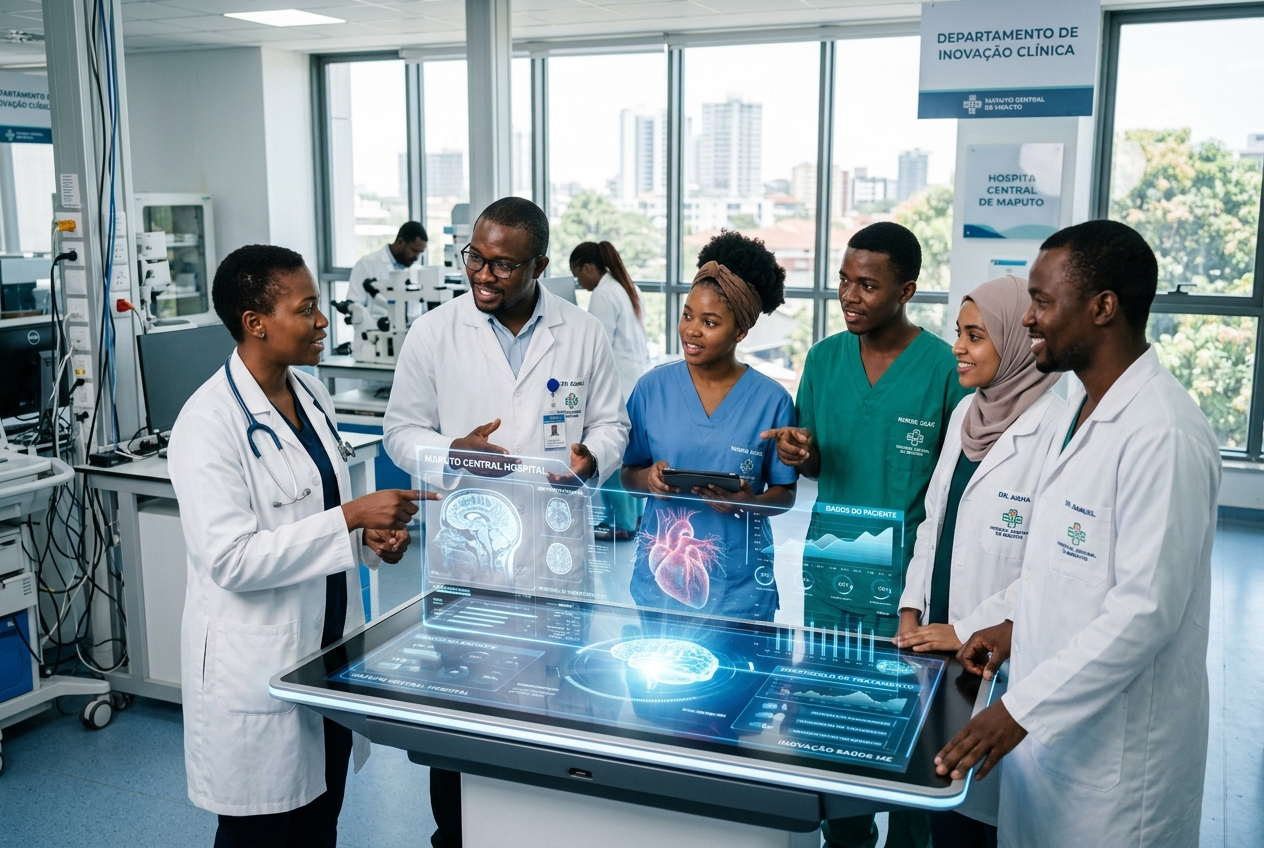
Healthcare professionals in Mozambique engage with holographic technology, symbolizing the integration of innovation into the nation's medical future.
Emerging New Careers in Digital Health in Mozambique
The rapid digitalization of the health sector in Mozambique is catalyzing the emergence of a range of new professions. These careers represent the fusion of traditional medical knowledge with advanced technical skills, directly responding to the needs of an increasingly interconnected and technologically dependent health system. For professionals aspiring to lead innovation and ensure their relevance in the 2026 job market, specializing in these emerging areas is a fundamental strategic step. The demand for these new professional profiles is growing exponentially, offering not only competitive salaries but also the unique opportunity to be at the forefront of healthcare transformation in Mozambique. Inademy offers training programs that prepare you for these future careers.
Telemedicine Specialist: The Digital Link to Health
The telemedicine specialist is an essential professional for the effective and safe operation of remote health platforms. Their responsibilities range from configuring and maintaining teleconsultation equipment to providing technical support to patients and professionals during virtual sessions. This professional manages appointments, ensures service continuity, and guarantees compliance with strict health data privacy and security regulations. The role requires a solid understanding of communication technologies, familiarity with specific medical software, and strong problem-solving skills in real-time. In Mozambique, where expanding healthcare access in rural areas is a national priority, the telemedicine specialist plays a crucial role, connecting communities to quality medical care regardless of geographical distance. Mastering this area today means securing a promising career tomorrow, and Inademy offers the courses to empower you.
Health Data Analyst: Deciphering Information to Improve Care
With the increasing digitalization of health records, the ability to analyze and interpret large volumes of data has become an indispensable skill. The health data analyst is the professional responsible for extracting valuable insights from clinical, operational, and epidemiological data. By applying statistical and data visualization tools, this professional contributes to identifying health trends, evaluating the effectiveness of therapeutic interventions, predicting disease outbreaks, and optimizing resource allocation. In Mozambique, where evidence-based decision-making is crucial for public health policy planning, the data analyst plays a strategic role. The demand for these professionals has been growing significantly, reflecting their increasing importance in health management. If you have an affinity for numbers and an analytical mind, this could be your area of excellence. Explore training options and see available vacancies in jobs in Mozambique, many of which focus on data analysis.
Medical Software Developer: Creating the Tools of the Future
The medical software developer is the architect behind the applications and systems that drive digital health. These professionals design, develop, and maintain essential software such as electronic health record systems, telemedicine platforms, remote patient monitoring applications, hospital management systems, and AI-assisted diagnostic tools. The work requires a deep understanding of programming languages, agile software development methodologies, and ideally, an understanding of the specific regulations and needs of the healthcare sector. In Mozambique, the need to adapt global technological solutions to local realities, or to develop innovative applications for the Mozambican market, creates a unique opportunity for software developers with vision and creativity. Close collaboration between developers and healthcare professionals is fundamental to ensure that the software developed is not only technically robust,