

Delivery Driver in Mozambique: Earnings and What to Demand
Delivery drivers in Mozambique have no legal minimum wage. Learn what earnings are realistic and what contract rights you should demand before starting.

A delivery driver in Mozambique — whether by motorbike or bicycle — has no legal minimum wage: the relationship is one of service provision, and earnings are per task.
The most cited public reference is Yango's advertisement, which on its delivery driver recruitment page promises up to 21,000 MT per month — a marketing figure, not a floor. What can be demanded right now, under current law (Labor Law 13/2023), are 5 concrete things: a written contract, transparent commission, account blocking criteria, equipment, and insurance.
This guide answers the 2 main questions on the topic: how much you earn (what is verifiable and what is not) and what you should demand before starting. There is no guaranteed earnings figure — there is a range you can plan for, and a set of conditions you can demand.
How Much You Earn: What Is Verifiable and What Is Not
The only public earnings figure is Yango's advertisement: up to 21,000 MT/month, on the app's driver page. It is a recruitment number — it describes potential, not the reality for beginners. There are no public statistics in Mozambique on average delivery worker earnings, and anyone who gives you a figure claiming "the average is X" is making it up.
Real earnings depend, in practice, on 4 things: hours worked, area (the city center pays more because order density is higher), demand (time and day of the order), and the platform's commission. The commission is the percentage taken in between. It is the combination of these 4 variables that determines whether you reach 21,000 MT at the end of the month.
To plan, use an example — not a fact: 8 hours a day, 12 deliveries a day, 80 MT per delivery, 22 days. That equals around 21,000 MT gross per month, before commission and fuel. This is the arithmetic you should calculate with your own numbers, not the promise made by the app.
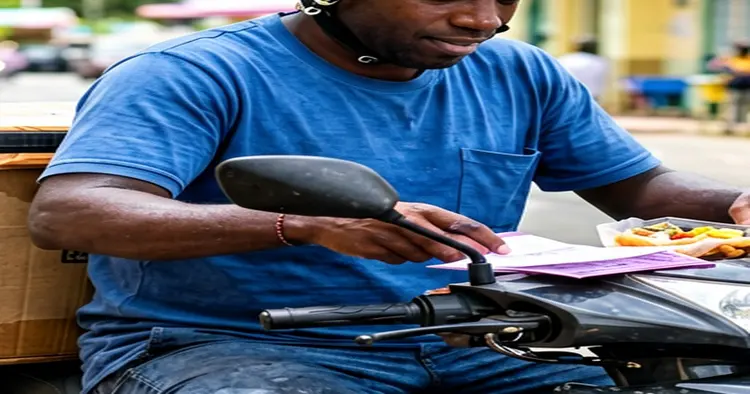
Motorbike or Bicycle: The Cost Nobody Tells You
The choice of transport changes net earnings, and the difference lies in fixed costs. A motorbike carries costs for fuel, maintenance, helmet, and, if bought on credit, installment payments — each payment eats into daily earnings. A bicycle carries physical strain costs and lower payload capacity, which limits hourly order volume.
The test before starting: create 2 columns. On one side, your expected daily gross earnings. On the other side, fuel, maintenance, insurance, financing installments (if any), and downtime hours. The difference is your real earnings — and that is what you should compare to the sector minimum wage to see if you are above or below the threshold.

What You Should Demand — The 5 Items
These 5 points do not depend on new laws. They are conditions you can demand when joining the platform. When the relationship is employment-based, the General Labor Inspectorate (Inspecção-Geral do Trabalho) evaluates them:
- Written contract stating the arrangement: contractor or employee — and what changes under each. Without a contract, there is no basis to demand anything.
- Written commission rate — the percentage by service type. This is the variable that affects net earnings the most, and the one least frequently put in writing.
- Account blocking criteria — rating thresholds, conduct rules, what leads the app to deactivate your tasks, and how to appeal. Arbitrary deactivation without an appeal channel erodes earnings the most.
- Equipment and insurance — who provides the motorbike, phone, and helmet; and whether there is accident coverage during shifts. This is the item that protects your health and ability to work.
- A complaint channel with a response deadline — what is in writing is what can be enforced.

3 Delivery Driver Profiles: What the Arithmetic Shows
The 3 profiles below are planning examples, not forecasts — numbers vary depending on your area, app, and hours.
Profile 1 — full-time, motorbike. 8 hours/day, 12 deliveries, 80 MT per delivery: about 21,000 MT gross/month. Subtract fuel (around 2,500 MT/month, depending on price), platform commission (around 30%, to be confirmed in the app) and you get the net total. Net income is the number you can plan with.
Profile 2 — part-time, bicycle. 4 hours/day, 6 deliveries, 80 MT: about 10,500 MT gross/month, no fuel costs — but with more downtime to rest and reload. This profile fits those supplementing another income source.
Profile 3 — weekends and peak hours. Working only lunch hours and weekends: hourly earnings are higher, but monthly totals are lower. This fits those using the app as a side hustle, not a main job.
Choose the profile you can sustain — and map out the 2 columns (gross earnings, costs) before starting. That is the only predictable part; the rest is guesswork.
What Varies from App to App
Rules are not the same across all platforms. The same street in Maputo has several delivery apps operating, each with its own commission rate, schedule flexibility, and account blocking policies. What this means: what is guaranteed on one app is not guaranteed on another.
Therefore, comparing before signing up isn't just about "which pays more per delivery". It is about "which has lower commission, less arbitrary deactivations, and written equipment terms". Compare all 3 on paper per app — your choice changes based on these answers.
Legal Framework: What Applies Today
Current rule: the presumption under Labor Law 13/2023. If the app dictates schedules, provides equipment, and doesn't allow you to decline work, it is an employment relationship. In that case, worker rights (minimum wage, paid leave, insurance) apply regardless of whether the app recognizes it. The Labor Law 13/2023 guide explains the factual assessment test.
In parallel, a targeted legal revision discussing platform worker protection is currently under debate in government — it is under discussion, not yet approved. The Guide's article on digital platforms covers the 4 points under debate. This will define your work status once enacted.
Before Joining an App: The Checklist
- Check the commission rate by service type — it is the variable that eats away at earnings the most and is rarely documented in writing.
- Equipment — who provides the motorbike, helmet, and phone; and whether accident insurance is provided during shifts.
- Account blocking criteria — what causes task deactivation and how to appeal.
- Check platform reputation on app stores — reviews from other drivers are the closest thing to realistic earnings figures.
- Plan your hours — with task-based pay, total hours define your monthly total; there is no minimum salary.
Create your free profile on Inademy — new job alerts arrive via email and WhatsApp. And if formal contract employment is your goal, the sector minimum wage is listed in the 19 sector minimum wages table; the Guide's CV template is your starting document.
In Summary: What to Do Today
3 steps before starting. Take all 3 today, not tomorrow.
- Your numbers — hours, deliveries, location. Write them down and do not build plans solely on Yango's ad.
- The 5 items in writing — contract, commission, account blocking rules, equipment, and complaint channel before your first delivery. What is in writing is what can be enforced.
- The formal sector — if your goal is a contract, check your sector in the 19 minimum wage table and prepare your CV: delivery experience counts in logistics and transport, and formal job openings appear on Inademy.
Frequently Asked Questions
1. Is "up to 21,000 MT/month" guaranteed?
No. It is Yango's recruitment advertisement — a potential figure, not a minimum wage. Real earnings depend on hours worked, location, demand, and commission rates. Do not build financial plans around advertising figures.
2. Can I use my own bicycle?
Yes, if accepted by the platform. Operating costs change (no fuel, maintenance vs. physical effort) and hourly carrying capacity limits order volume. The decision is yours once you calculate both columns.
3. Who pays for the helmet?
It depends on platform rules and your contract. This is an item you must demand in writing — who provides equipment and shift accident insurance. If it is not written down, it doesn't exist.
4. What if I have an accident during a delivery?
It depends on legal classification: if it is an employment relationship, workplace accident insurance applies; if service provision, contract terms dictate. This is precisely what ongoing legal revisions aim to clarify — and an item you should demand in writing now.
5. Does delivery work count toward formal employment later?
It counts as experience in the logistics and transport sector — and the General Labor Inspectorate assesses employment status based on facts. An active profile on Inademy connects you to opportunities: formal sector openings appear there, and job alerts arrive via email and WhatsApp.
6. What if the app refuses to put the commission rate in writing?
Refusing written terms does not invalidate rights — it affects proof. If an employment relationship exists based on facts, the General Labor Inspectorate evaluates it regardless of what the app writes in the contract.
Refusal increases the effort needed to prove terms agreed at sign-up. That's why written terms are far easier to enforce and carry more weight when proving agreed commission rates.
Sources
Yango MZ (2026) — driver/delivery page, advertised earnings of up to 21,000 MT/month; Labor Law 13/2023 (presumption of employment relationship); MZNews (August 27, 2026) — targeted Labor Law revision under debate in government; Council of Ministers (April 28, 2026) — table of 19 minimum wages by sector, effective since April 1, 2026.