

Tech Careers (ICT): Salaries in Mozambique
Mozambique ICT careers: developer salaries from 27,089 to 138,999 MT per month, entry pathways, certifications, portfolio, and remote work.

The short answer
- ICT market range: software developers earn between 27.089 and 138.999 MT per month in 2026, according to WageIndicator — one of the highest starting salaries in the country.
- Top hiring roles: web and mobile development, networking and infrastructure, technical support, data analysis, and banking systems management.
- How to enter without a degree: technical certifications, a portfolio of real projects, and support/helpdesk experience are the classic path.
- Who hires: telecommunications, banks, mobile payment operators, NGOs, and service companies — as well as foreign companies offering remote work.
- Training options: public and private universities, technical institutes, and online courses complete the path.
Technology is the field where the difference between those who know and those who do not is most visible in pay.
A developer with a strong portfolio can start out earning what a senior manager makes in traditional sectors — and demand continues to grow with mobile payments, digital banking, and online services in Mozambique. This guide from the Inademy Guide shows the real paths to entering and advancing in the field.

How much tech workers earn
The range published by WageIndicator for software developers in Mozambique, in 2026, spans from 27.089 to 138.999 MT per month. This is market data, not an official pay scale — and the gap between the extremes is explained by three variables: tech skills mastered, proven experience, and employer.
Compared to the rest of the country, the field is unique: the nation's highest minimum wage — banking, at 20.361,43 MT — falls below the start of the developer range. The distance between the bottom and top of the range reflects experience levels and mastered technologies in the Mozambican market.
There is also the option of remote work for foreign companies. Hired in a strong currency, a Mozambican developer can multiply the local range — but expectations are proportional: technical English and a verifiable portfolio. To calculate what remains of any offer, the net vs gross salary guide does the math.
Roles the market is looking for
- Web and mobile development: service, payment, and e-commerce applications dominate demand;
- Networking and infrastructure: telecom operators, internet service providers, and large companies need people to install and maintain networks;
- Technical support and helpdesk: the most accessible entry point, requiring secondary education and offering plenty of on-the-job learning;
- Data analysis: banks, insurance companies, and NGOs look for people who turn data into decisions;
- Financial systems: the digitization of banking has created constant demand for people who know payment systems and integrations.
Programming-related roles — systems analysts, software engineers, testers — follow the same hiring logic: proof of real work is worth more than a degree alone.
How to get in without a degree
Technology is the most accessible field in the Mozambican market for anyone coming from outside the traditional academic path:
- Choose one specialty and not ten: web development, networking, or data. Depth in one area is worth more than basic knowledge across all of them.
- Earn recognized certifications — online certified courses, local bootcamps, and training from technical institutes. The institution's name matters less than demonstrated skill.
- Build a portfolio with real projects: websites for local businesses, simple tools for NGOs, open-source contributions. GitHub or your own website serve as a showcase.
- Start in support or an internship — helpdesk roles hire candidates with secondary education and open doors internally to technical roles.
- Apply with proof, not promises: your CV should point to your portfolio. The template is in the guide on how to create a CV in Mozambique.
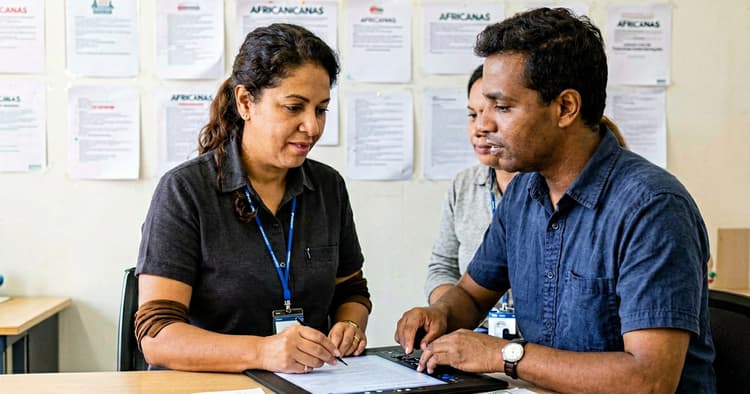
Which employers to look for
The employer determines half of your IT salary. Telecom operators and banks pay at the top of the local pay scale; service companies and retail stay closer to the bottom.
NGOs and international organizations hire using their own pay scales, often on externally funded projects. And LinkedIn for job hunting is now an essential channel for technical roles — many remote contracts originate from a well-built profile.
For those who prefer starting their own business, offering tech services to local companies — websites, management systems, networks — is the most direct way to convert skills into income, with the advantage of serving a market you already know.
ICT in the context of high-demand careers
Technology intersects with all other sectors: mining needs systems, agriculture needs data, banking needs applications. This cross-sector reach is why demand withstands economic cycles — and why the sector tops the guide to high-demand careers in Mozambique in 2026.
For young people choosing their education, the first-job CV guide shows how to turn academic projects into presentable experience.
How Inademy helps you
On Inademy, tech jobs from banks, telecom providers, NGOs, and local companies are posted — with role descriptions and salary details when disclosed. Profiles are free, accept CVs in PDF format, and job alerts arrive via email and WhatsApp. Enable alerts for your field and province: technical roles usually close in days, not weeks.
Read also
- Minimum Wage in Mozambique: official table and history
- Teacher Salary in Mozambique 2026: how much they earn
- Driver Salary in Mozambique 2026: how much they earn
Where these numbers come from
- WageIndicator 2026 – Mozambique: "Employment and Salary - Software developers" page (range from 27.089 to 138.999 MT/month), accessed in September 2026.
- Local IT salary surveys (2026): tables published by Mozambican technology companies, used only as a qualitative reference for level ranges.
- Minimum wage 2026: table effective since April 1, 2026 (AIM, April 28, 2026), used for comparison with the banking sector floor.
Career Progression and Specialisation in IT
In technology, career progression follows specialisation. Those who start as junior programmers advance to developers, then to software engineers, and ultimately to architecture or product management.
There are also data and security career paths. Data analysts, data scientists, and cybersecurity specialists have their own progression track, with earnings that rise quickly.
The right certifications and tools open doors. Professionals skilled in cloud, testing, and product management command higher value than those who only code.
Technology job vacancies in Mozambique are concentrated in Maputo and, to a lesser extent, Nampula. Outside these cities, remote work is the primary way to access high-value projects.
Technical English is also essential, serving as the doorway to international projects with earnings above the local average.
Those who combine coding skills with management and build project experience advance faster into team lead and product leadership roles.
Keep a record of your projects, certifications, and specialisations. This track record underpins career progression and salary growth in Mozambique's technology sector.
Tech vacancies in Maputo focus on development, data, and cybersecurity. Specialists in these fields see the highest market demand.
Continuous learning in programming languages, cloud technologies, and management tools is equally valuable. Staying updated raises a professional's value and supports career growth.
In the end, those who advance in the sector combine specialisation, certification, and a project portfolio. This triad supports career progression and raises earnings in Mozambique's tech sector.
Document every project, certification, and specialisation. In the tech sector, this record demonstrates career growth and supports salary negotiations.
In practice, combine specialisation, certification, continuous learning, and a portfolio of projects. This combination supports career progression and boosts earnings in the tech sector.
Frequently asked questions
How much does a software developer earn in Mozambique?
Between 27.089 and 138.999 MT per month in 2026, according to WageIndicator. Early-career salaries sit closer to the bottom of the range; proven experience and high-demand technologies push earnings toward the top.
Do I need a university degree to work in IT?
No. It is a field where portfolios and certifications carry more weight than a degree. Many professionals started in technical support or with personal projects and advanced through demonstrated competence.
Which language should I learn first?
The one that solves problems in your market: web development is the most in-demand path with the most local job openings. What matters is depth in a single specialty, not the length of your programming language list.
Is it worth working remotely for foreign companies?
Yes — salaries in hard currency far exceed local ranges. However, it requires good technical English, a verifiable portfolio, and deadline discipline. Start by building local experience before competing in the international market.
Are IT jobs only available in Maputo?
Maputo has the highest concentration, but telecom operators, banks, and technology-driven projects also hire in Beira, Nampula, and Quelimane. And remote work partially removes geographic boundaries.
I come from another field. Can I switch to IT?
Yes — career transitions in your 30s or 40s are common in this field. The strategy: keep your current job, study a specific specialty in the evenings, build two or three real projects, and apply for entry-level or hybrid roles that combine your previous background with technology.
In short, what to do today
- Choose a specialization — web, networking, data, or support — and map out available training.
- Start a real project this week: a website for a local business is worth more than ten standalone courses.
- Create a one-page CV pointing to your portfolio.
- Create a profile on Inademy, activate IT job alerts via WhatsApp, and apply early.
- Build a LinkedIn profile — it's where technical recruiters look first.