

INSS in Mozambique: Contributions and Protection, 2026
How much INSS deducts in Mozambique: 7% of salary (4% employer, 3% worker) and the benefits that protect you in illness, maternity, and old age.

The short answer
- Contribution rate: 7% of gross salary, remitted monthly to the INSS. 4% is paid by the company and 3% is deducted from the worker.
- Real example: on a gross salary of 10.622,50 MT, the worker's deduction is 318,68 MT.
- What it covers: sickness benefit, hospitalisation benefit, maternity and paternity benefits, old-age pension, and disability pension. The family is also protected through the death benefit.
- Maternity: the INSS pays at least 60 days of the 90 days of leave.
- Checking contributions: the official platforms SISSMO and M-Contribuição show your contributions.
Anyone working under a contract in Mozambique sees a deduction line on their payslip every month that goes to the INSS — the National Institute of Social Security.
Many people know the deduction exists, but do not know what it actually buys them. In this guide from the Inademy Guide, we explain how much is paid, who pays what, and what benefits you receive in return, complete with figures and official sources.
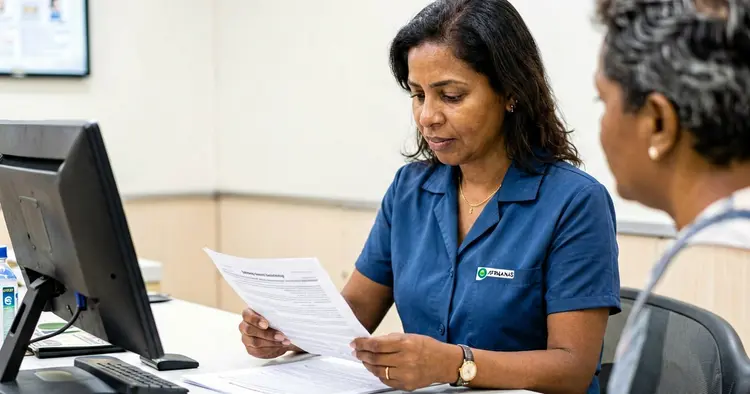
How much is paid to INSS
The social security contribution rate is 7% of gross salary. INSS itself explains the breakdown on its official page: 4% is paid by taxpayers — companies — plus 3% deducted from beneficiaries, that is, workers. In total, the employer transfers this 7% monthly to the institute.
A concrete example using the manufacturing industry minimum wage in 2026: on a gross amount of 10.622,50 MT, the worker's 3% corresponds to 318,68 MT.
The company adds its 4% on top — which is not deducted from you. The net salary that reaches your account also depends on IRPS, the income tax; the full calculation is in the guide to net vs gross salary in Mozambique.
The INSS deduction is one of the deductions authorized by law even without your written authorization — unlike other deductions, which require your written consent. This is the difference between a legal deduction and a contractual deduction.
What the INSS gives you in return
Contributions buy protection in situations that cut income. The official list of benefits for workers includes:
- Sickness benefit — when health prevents you from working;
- Hospitalisation benefit;
- Maternity and paternity benefits — the INSS pays at least 60 days of the 90-day maternity leave;
- Old-age pension — income when your career ends;
- Disability pension — when work capacity is reduced.
The family is also protected: in the event of the death of a worker or pensioner, the death benefit is paid as a single payment. Each benefit has its own eligibility conditions — contribution period, documentation — which the INSS publishes on its official pages and in provincial offices.
The rules for maternity and paternity leave are detailed in the guide on maternity and paternity leave in Mozambique.
Taxpayer number and contribution records
The first step is to be registered. Every worker must have a social security taxpayer number assigned by the INSS, under which contributions are recorded month by month. It is this record that builds entitlement to future benefits—including pensions.
Today it is possible to track everything without leaving home. The official platforms are SISSMO and M-Contribuição, where taxpayers and beneficiaries can check records and services. The institute's general contact details in Maputo are located at Avenida 24 de Julho n.º 3549, with telephone 21 227300 and email inss@inss.gov.mz.

If the company does not deduct or remit contributions
The deduction appears on your payslip, but remitting it to the INSS is the employer's responsibility. If you do not see the deduction on a salary under a formal contract, or if you suspect the company deducts it but fails to pay it over, the loss is yours in the future — pensions depend on registered contributions.
In these cases, the right step is to ask human resources for clarification in writing and, if there is no response, contact the General Inspectorate of Labour. The list of workers' rights in Mozambique helps you understand the extent of the company's obligations.
And if your case involves a salary that never had a written contract, the guide on employment contracts: types and rules explains why the absence of paperwork does not eliminate your rights.
INSS and Other Salary Deductions
A formal worker's payslip usually has three main sections: base salary, allowances, and deductions.
INSS is one of them; IRPS is the other major deduction. What often confuses people are allowances — meal, transport, 13th month — which are not all treated the same way. The guide to salary allowances in Mozambique separates what is mandatory from what is customary.
It is also worth knowing the broader context: the guide on what changed under Law 13/2023 summarizes the new employment contract rules, and the public sector minimum wage guide shows the state baseline.
How Inademy helps you
A formal contract job is what connects your work to INSS protection. On Inademy, job openings are posted by real companies and applying is direct and simple. Your profile is free, accepts your PDF CV, and new job alerts arrive via email and WhatsApp — so you never miss an opportunity with a formal contract and proper payslip.
Read also
- Minimum Wage in Mozambique: official table and history
- Teacher Salary in Mozambique 2026: how much they earn
- Driver Salary in Mozambique 2026: how much they earn
- Pension funds in Mozambique: private vs INSS
Where these numbers come from
- INSS — National Institute of Social Security (inss.gov.mz): "Contribution rate – Contributor" (7% = 4% + 3%), "Rights and Obligations of the Contributor", "TCO worker benefits", "Death benefit", and "Minimum Wages in Force" pages. Pages consulted in September 2026.
- Labour Law, Law No. 13/2023 (Boletim da República): Art. 124 (deductions from remuneration) and maternity rules. In force since 21 February 2024.
- Minimum wage 2026: table in force since 1 April 2026, published in the Boletim da República and reported by AIM on 28 April 2026.
How to track contributions and rights
Workers should track their contribution record to ensure their employer is declaring payments. This record forms the basis of your right to protection and determines your final pension amount.
Keep your payslips showing the INSS deducted. In the event of a dispute, this proof upholds your right to benefits and pensions.
In practice, combine tracking your record, saving payslips, and verifying employer declarations. Doing so protects your rights at the end of your career.
Also check application deadlines. Anyone applying for a benefit or pension past the deadline risks losing their entitlement. Always keep a record of the application date and submission confirmation.
In practice, combine checking your record, saving payslips, and paying attention to deadlines. Doing so protects your rights at the end of your career and supports your pension amount.
Also keep track of your contribution record, payslips, and application deadlines. Together, these safeguard your rights and secure your pension amount at retirement.
Frequently Asked Questions
How much does INSS deduct from my salary?
3% of your gross salary. The company pays the remaining 4% of the overall 7% rate on top of your salary. On a gross salary of 10.622,50 MT, your deduction is 318,68 MT.
What is the INSS deduction for?
It funds your social protection: sickness benefit, hospitalization benefit, maternity and paternity benefits, old-age pension, and disability pension. The family also receives a death benefit in the event of the worker's or pensioner's death.
Who pays for maternity leave?
INSS pays for at least 60 days of the 90-day maternity leave. Maternity benefit is part of the official list of worker benefits.
How do I know if the company is submitting my contributions?
Check the official INSS platforms — SISSMO and M-Contribuição — or request a statement at a provincial office. If the deduction appears on your payslip but the record does not show up, query the company in writing.
I work without a contract. Am I entitled to INSS?
Contribution registration starts from a formal contract. Working without a written contract does not eliminate the employment relationship or your rights, but it makes registering contributions harder — all the more reason to regularize your status, starting with the General Labour Inspectorate if necessary.
When am I entitled to an old-age pension?
The old-age pension is one of the official INSS benefits, with specific eligibility conditions — age and contribution period — published by the institute. The more years of registered contributions you have, the stronger your entitlement.
What is the social security contribution number?
It is the number that identifies you in the INSS system and under which your contributions are recorded. It is assigned by the institute and stays with you throughout your working life.
In summary, what to do today
- Check your payslip to see if the 3% deduction appears and if your tax number is listed on the documents.
- Register or log in to the SISSMO and M-Contribuição platforms to view your history.
- If the deduction does not appear, contact human resources in writing.
- Keep your contracts and payslips — they are proof of your contributions.
- If you are looking for formal employment with a proper contract and payslips, create a profile on Inademy and activate WhatsApp alerts.
Official source: Law No. 13/2023 (Labour Law) is available as a PDF on the website of Mozambique's Supreme Court (Tribunal Supremo): official text (PDF).